
Quick Guide to IEC 62443: Securing Industrial Control Systems
In today's interconnected industrial landscape, protecting operational technology (OT) environments has become a critical priority. IEC 62443 stands as the gold standard for industrial cybersecurity, providing a comprehensive framework specifically designed for the unique challenges of Industrial Automation and Control Systems (IACS).
Part 1: Understanding IEC 62443
What is IEC 62443?
IEC 62443 is the globally recognized series of standards developed by the International Electrotechnical Commission (IEC) specifically for securing Industrial Automation and Control Systems (IACS). Unlike generic IT security frameworks that focus primarily on data confidentiality, IEC 62443 addresses the unique challenges of operational technology environments where safety, reliability, and continuous operation are paramount.
The standard was developed through collaboration between the ISA (International Society of Automation) and IEC, combining decades of industrial security expertise with international standardization. Today, it serves as the definitive reference for organizations seeking to protect their critical infrastructure from cyber threats.
Why IEC 62443 Matters for OT Security?
Traditional IT security frameworks like ISO 27001 were designed for corporate environments where data confidentiality is the primary concern. However, in industrial environments, the priorities are fundamentally different:
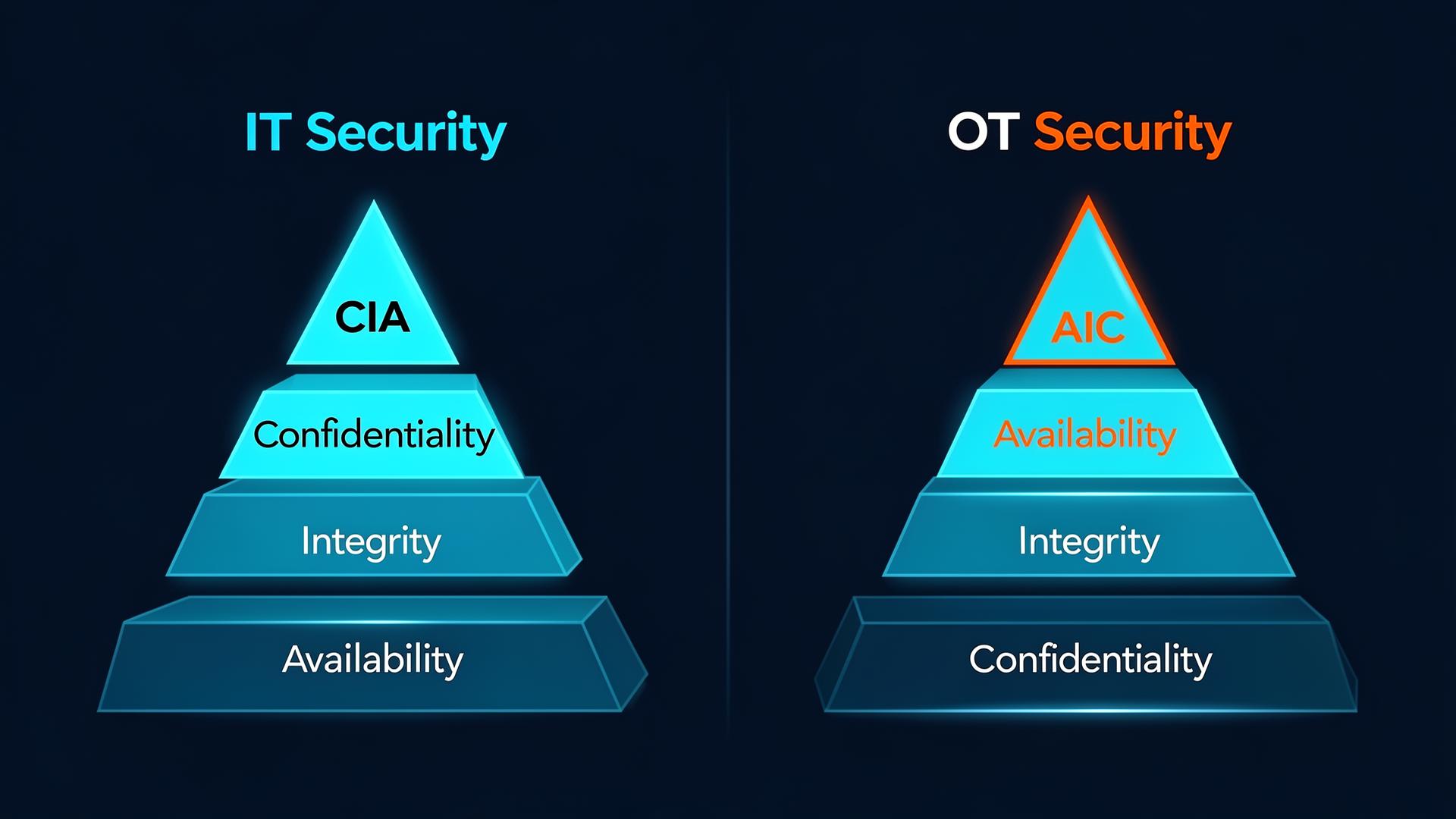
Safety First: Protecting human life and preventing environmental damage takes absolute precedence. A cyberattack on a refinery, power substation, or offshore platform could have catastrophic real-world consequences.
Availability: Industrial processes often cannot be stopped. Downtime in an oil refinery, electric generation facility, or water treatment plant can cost millions per hour and affect critical services that communities depend upon.
Integrity: Maintaining accurate control of physical processes is essential. Manipulated sensor data or control commands in a gas pipeline or electrical grid could lead to equipment damage, service disruptions, or safety incidents.
Confidentiality: While important, protecting proprietary processes and data typically ranks after safety and availability in OT environments.
This inversion of the traditional CIA (Confidentiality, Integrity, Availability) triad to AIC (Availability, Integrity, Confidentiality) is why industrial environments need specialized security frameworks like IEC 62443.
The History and Evolution of IEC 62443

- 2002: ISA99 committee established to develop industrial security standards
- 2007: First ISA-99 standards published
- 2010: IEC partnership formed for global adoption
- 2013: Full IEC 62443 series framework released
- 2018+: Ongoing updates and continuous evolution
Part 2: The Structure of IEC 62443
The IEC 62443 series is organized into four main categories, each addressing different aspects of industrial cybersecurity:
Series 1: General Concepts (IEC 62443-1-x)
This foundational series establishes the terminology, concepts, and models that underpin the entire framework:
Standard | Description |
|---|---|
IEC 62443-1-1 | Terminology, concepts, and models |
IEC 62443-1-2 | Master glossary of terms and abbreviations |
IEC 62443-1-3 | System security conformance metrics |
IEC 62443-1-4 | IACS security lifecycle and use cases |
IEC 62443-1-5 | Scheme for IEC 62443 security profiles |
Series 2: Policies and Procedures (IEC 62443-2-x)
This series focuses on the organizational and procedural aspects of security management:
Standard | Description |
|---|---|
IEC 62443-2-1 | Security program requirements for IACS asset owners |
IEC 62443-2-2 | IACS security program ratings |
IEC 62443-2-3 | Patch management in the IACS environment |
IEC 62443-2-4 | Security program requirements for IACS service providers |
IEC 62443-2-5 | Implementation guidance for IACS asset owners |
Series 3: System-Level Security (IEC 62443-3-x)
Standard | Description |
|---|---|
IEC 62443-3-1 | Security technologies for IACS |
IEC 62443-3-2 | Security risk assessment for system design |
IEC 62443-3-3 | System security requirements and security levels |
Series 4: Component-Level Security (IEC 62443-4-x)
Standard | Description |
|---|---|
IEC 62443-4-1 | Secure product development lifecycle requirements |
IEC 62443-4-2 | Technical security requirements for IACS components |
Part 3: Security Levels Explained
One of the most important concepts in IEC 62443 is the Security Level (SL) model. This provides a structured way to match security controls to the threat landscape.

The Four Security Levels
Level | Protection Against | Threat Actor | Example |
|---|---|---|---|
SL-1 | Casual or Coincidental Violation | Accidental users, curious employees | Maintenance technician accidentally accessing wrong HMI screen |
SL-2 | Intentional Violation Using Simple Means | Script kiddies, disgruntled employees | Former employee using default credentials to access controls |
SL-3 | Sophisticated Attacks Using Moderate Resources | Hacktivists, criminal organizations | Organized group targeting pipeline SCADA with ICS-specific exploits |
SL-4 | State-Sponsored Attacks With Extensive Resources | Nation-state actors, APT groups | Nation-state actor targeting electrical grid critical infrastructure |
Types of Security Levels
IEC 62443 defines three types of security levels that work together:
- Target Security Level (SL-T): The desired level of security based on risk assessment
- Achieved Security Level (SL-A): The actual level achieved by implemented countermeasures
- Capability Security Level (SL-C): The level a component or system is capable of providing
The goal is to ensure that SL-A meets or exceeds SL-T for each zone in your environment.
The Seven Foundational Requirements

IEC 62443 defines seven Foundational Requirements (FRs) that form the basis for all security controls:
Requirement | Name | Description |
|---|---|---|
FR-1 | Identification and Authentication Control | Verify the identity of users, processes, and devices before granting access |
FR-2 | Use Control | Enforce authorized access and prevent unauthorized use of system resources |
FR-3 | System Integrity | Ensure the integrity of the IACS to prevent unauthorized manipulation |
FR-4 | Data Confidentiality | Protect confidential information from unauthorized disclosure |
FR-5 | Restricted Data Flow | Segment the IACS to limit unnecessary data flows between zones |
FR-6 | Timely Response to Events | Respond to security incidents in a timely manner to minimize impact |
FR-7 | Resource Availability | Ensure the availability of the IACS against denial of service attacks |
Part 4: Zones and Conduits - The Defense-in-Depth Model
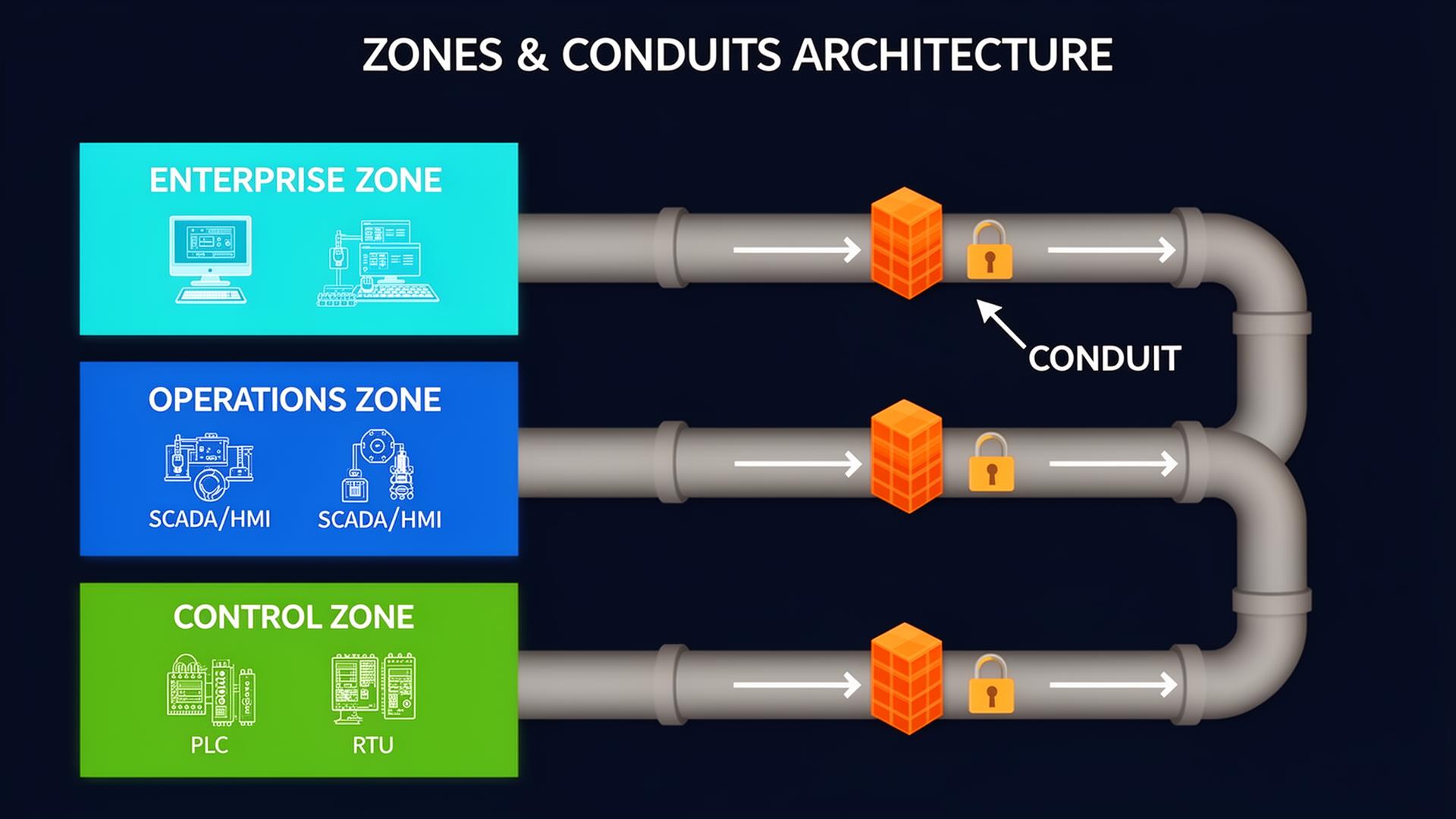
The zones and conduits model is a cornerstone of IEC 62443, providing a practical approach to network segmentation and defense-in-depth in industrial environments.
Understanding Zones
A zone is a logical or physical grouping of assets that share common security requirements. Each zone is characterized by:
- A clearly defined security level requirement (SL-T)
- A common set of security policies and procedures
- Similar asset types and criticality levels
- Distinct network boundaries
Common Zone Types
Zone | Purdue Level | Description | Example |
|---|---|---|---|
Enterprise Zone | Level 4-5 | Business systems, ERP, email, corporate IT | Corporate SAP system, HR systems, email servers |
DMZ | Buffer | Data historians, jump servers | OSIsoft PI historian, secure jump server |
Operations Zone | Level 3 | SCADA servers, MES, operations management | Central SCADA master, pipeline management system |
Control Zone | Level 1-2 | Local SCADA, HMIs, PLCs, DCS, RTUs | Substation RTUs, protective relays, DCS controllers |
Safety Zone | Level 0-1 | SIS, Emergency Shutdown Systems, fire and gas | Platform ESD system, SIS for reactor protection |
Designing Effective Conduits
A conduit is a communication pathway between zones that must be secured. When designing conduits between zones, consider:
Control Type | Purpose | Example |
|---|---|---|
Firewall Rules | Allow only necessary protocols and ports | DNP3 from substations to SCADA master |
Data Diodes | One-way data flow from critical to less critical zones | Production data from offshore platform to monitoring |
Jump Servers | Controlled administrative access | Secure access to substation HMIs |
Protocol Conversion | Breaking protocol continuity between zones | Converting DNP3 to OPC-UA at zone boundary |
Deep Packet Inspection | Monitoring OT protocols for anomalies | Inspecting Modbus commands for unauthorized function codes |
Part 5: Implementing IEC 62443 - A Step-by-Step Guide
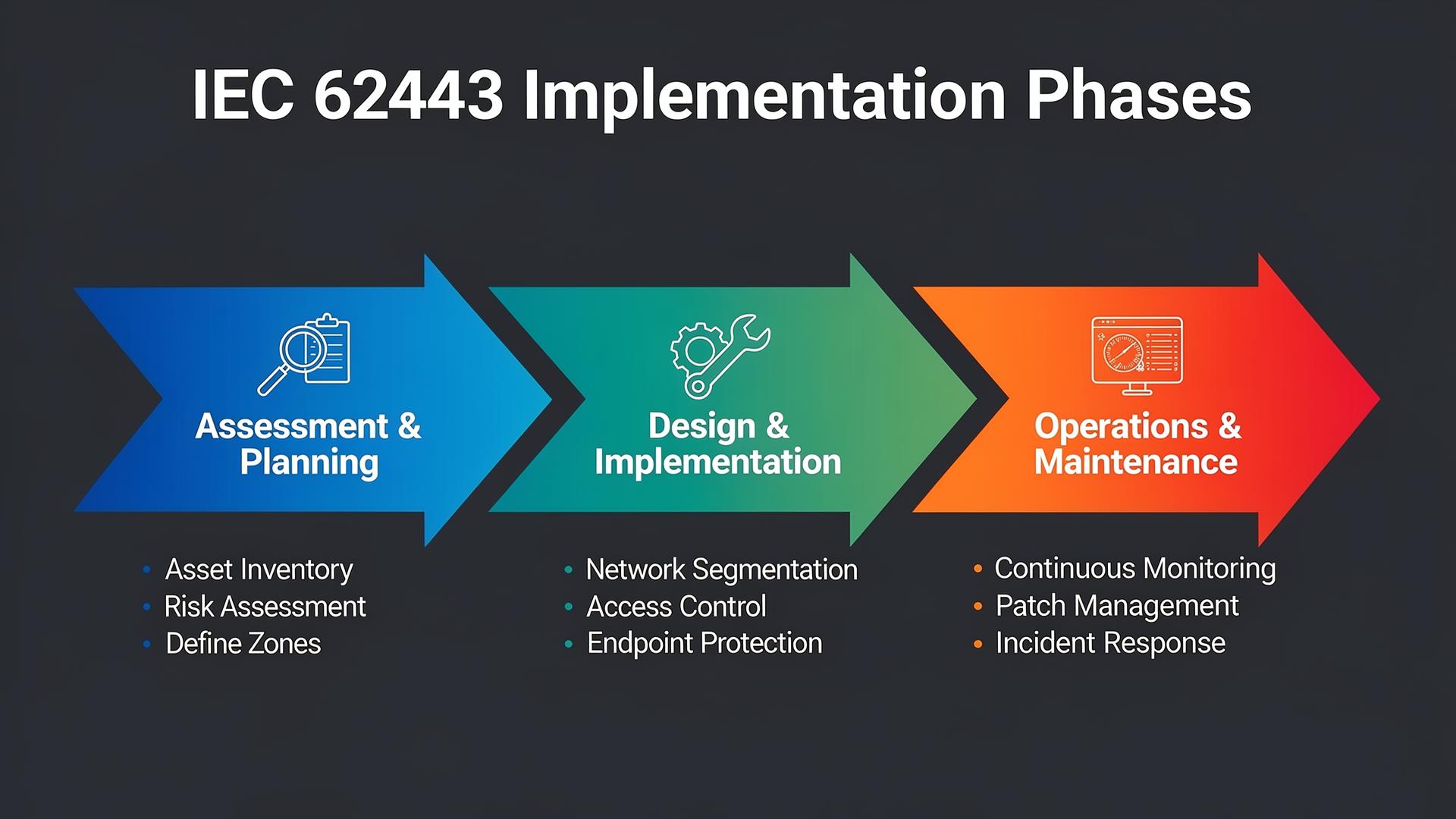
Phase 1: Assessment and Planning
Step 1: Asset Inventory
Begin by creating a comprehensive inventory of all IACS assets across your operations.
Step 2: Risk Assessment (IEC 62443-3-2)
Conduct a thorough risk assessment following IEC 62443-3-2 methodology:
- Identify potential threats and threat actors relevant to your sector
- Assess vulnerabilities in current systems
- Evaluate potential consequences
- Determine risk levels and priorities
Step 3: Define Zones and Security Levels
Zone Type | Recommended Security Level |
|---|---|
Safety systems (ESD, SIS) | SL-3 or SL-4 |
Primary control systems (DCS, SCADA) | SL-2 or SL-3 |
Operations management (historian, MES) | SL-2 |
DMZ systems | SL-2 |
Enterprise IT | SL-1 or SL-2 |
Phase 2: Design and Implementation
Network Segmentation:
- Industrial firewalls between enterprise, DMZ, operations, control, and safety zones
- VLANs separating control networks by function and criticality
- Data diodes for one-way flows from critical to less critical zones
Access Control:
- Multi-factor authentication for remote access to SCADA and HMIs
- Role-based access control limiting operator functions by responsibility
- Privileged access management for engineering workstations
Endpoint Protection:
- Application whitelisting on HMIs and engineering workstations
- Hardened operating systems with minimal services
- USB device control and removable media restrictions
Phase 3: Operations & Maintenance
Continuous Monitoring:
- 24/7 monitoring of OT networks with deep protocol visibility
- Anomaly detection for unusual Modbus, DNP3, or other protocol behavior
- Regular vulnerability assessments
- Periodic penetration testing
Patch Management (IEC 62443-2-3):
- Vendor patch monitoring and security advisory tracking
- Risk-based prioritization accounting for operational impact
- Testing in non-production environments
- Scheduled maintenance windows coordinated with operations
Part 6: IEC 62443 vs. Other Frameworks
Framework | Focus | Best Used For |
|---|---|---|
IEC 62443 | OT-focused, detailed IACS technical requirements | OT-specific implementation |
NIST CSF | Broad categories (Identify, Protect, Detect, Respond, Recover) | Overall program structure |
NERC CIP | Regulatory requirement for bulk electric system | Compliance demonstration (electric utilities) |
ISO 27001 | IT-focused, emphasizes confidentiality | Enterprise IT systems |
Conclusion: Getting Started with IEC 62443
Implementing IEC 62443 is a journey, not a destination. The standard provides a comprehensive framework, but success depends on taking a pragmatic, risk-based approach tailored to your organization's specific operational requirements and threat landscape.
Key Takeaways
- Start with Understanding Your Environment: A comprehensive compromise assessment establishes baselines and identifies vulnerabilities.
- Adopt the Zones and Conduits Model: Network segmentation aligned with the Purdue model is fundamental to industrial security.
- Match Security Levels to Risk: Not every zone needs SL-4 protection. Use risk assessment to determine appropriate levels.
- Focus on Fundamentals: Strong access control, continuous monitoring, and rapid incident response are essential at every security level.
- Prioritize Operational Continuity: Security controls must function during internet outages and infrastructure failures.
- Plan for the Long Term: Security is an ongoing process requiring continuous improvement.
Next Steps
- Assess Your Current Posture: Begin with a comprehensive compromise assessment
- Define Your Zones: Map your OT environment to the Purdue model
- Prioritize Remediation: Focus first on high-risk gaps
- Implement Monitoring: Establish continuous visibility with deep protocol inspection
- Establish Governance: Develop policies, procedures, and training programs
At FlintX, we build purpose-driven technology to protect critical infrastructure. Our platform delivers:
- •Real-Time OT Threat Intelligence & Monitoring
- •Automated ICS/SCADA Vulnerability Detection
- •Unified IT/OT Security Dashboard
- •Industrial Incident Response Automation
- •Built-in IEC 62443 Compliance Management
What's the Current Status of Your OT Environment?
Our experts can help you implement threat intelligence strategies tailored to your infrastructure.